

Origins
The Duwarth are among the oldest living beings to dwell beneath Nathakra’s crust, not born of flesh, but of root and rot. Legends whisper that they were the remnants of an ancient pact between the Thalindra, Lady of the Forest and the Elemental Plane of Earth. When death and decay first entered the world, the goddess wept, and her tears fell into the damp soil of the Deep. From that mingling of divine sorrow and fertile darkness, the first Duwarth grew, not as beasts or mortals, but as caretakers of the endless cycle.
They see themselves not as individuals but as threads of the greater tapestry, each one a fleeting echo of the same ancient consciousness, the Mycelial Mind.
Physical Description
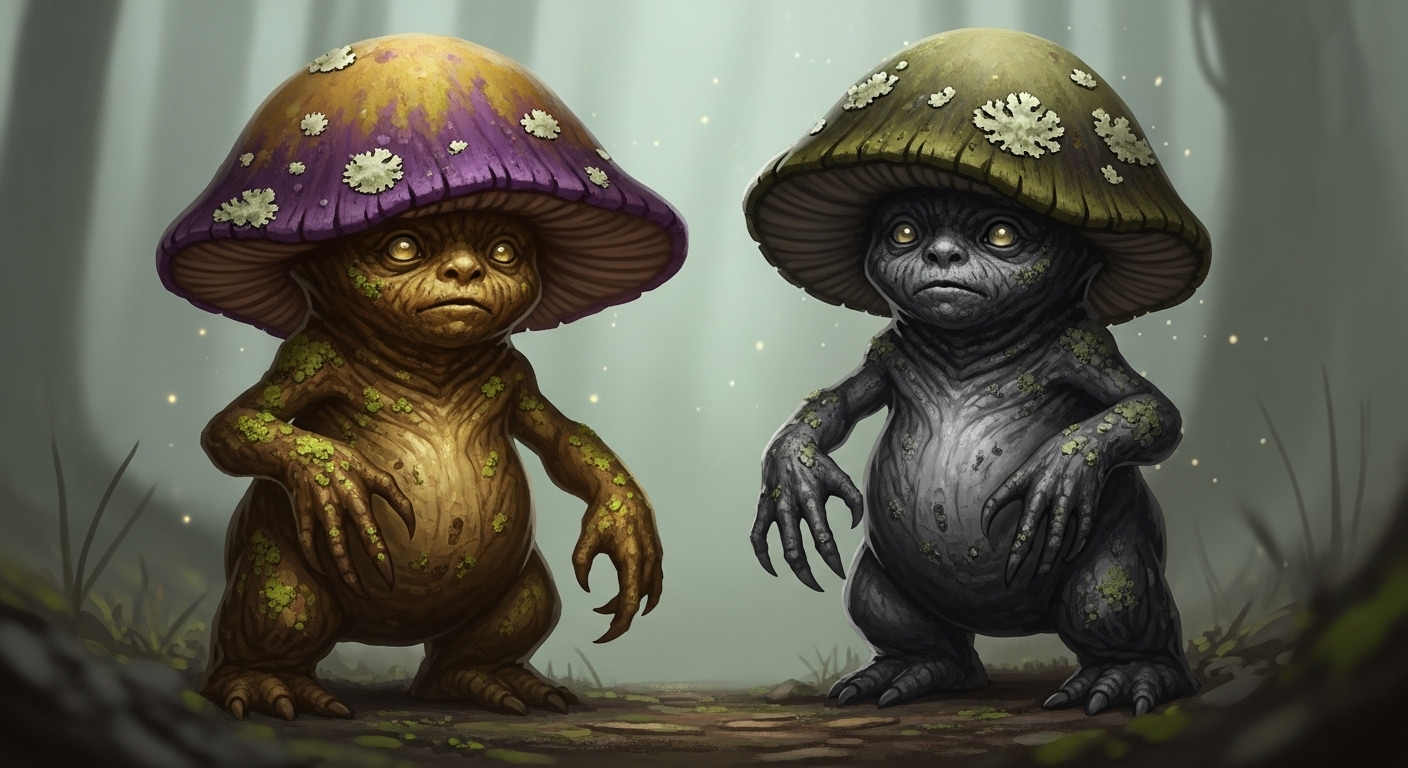
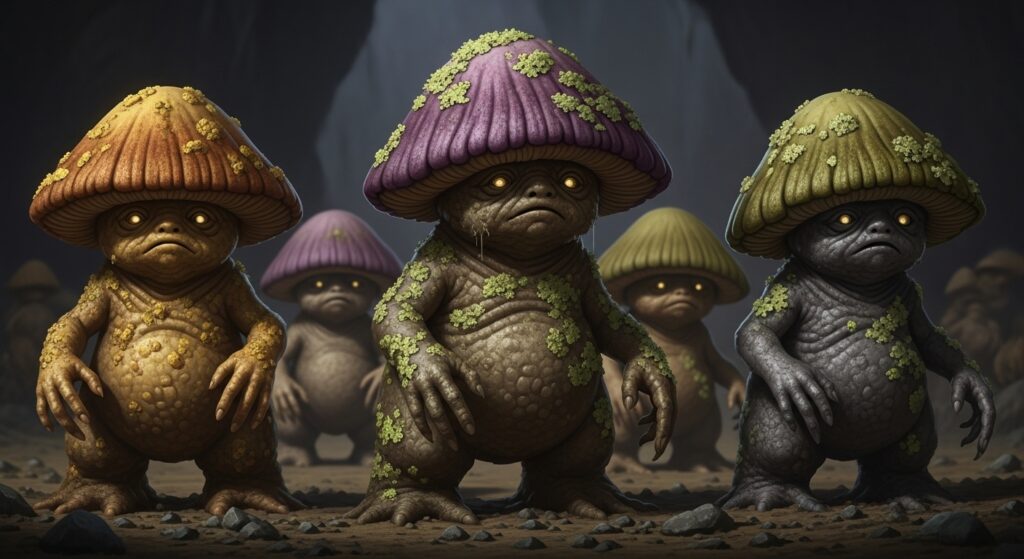
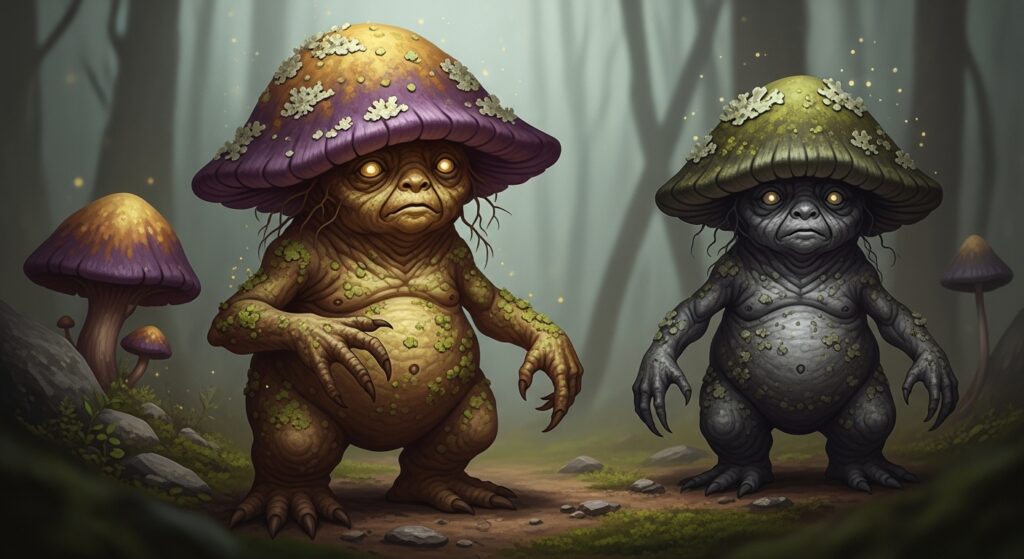
Standing roughly knee-high to a dwarf, Duwarth are squat, soft-bodied creatures with caps of varying hues, ochre, violet, mossy green, or ashen gray, depending on age and environment. Their skin is porous and textured like living bark, often covered in lichen or faintly glowing spores.
Eyes are small and luminescent, usually gold or milky white, set deep within expressive, childlike faces. Their fingers are long and root-like, capable of delicate work or merging briefly with soil and stone. When they move, it’s with a slow, deliberate gait, though when threatened, they can vanish into the earth or crumble into a puff of spores that later reform elsewhere.
Social Structure and Hierarchy
The Duwarth have no kings, chieftains, or council, hierarchy means little when death is merely renewal. Instead, leadership flows naturally toward those whose memories run deepest. The eldest “sprouts”, called Elder Caps, serve as guides and record-keepers, maintaining the continuity of knowledge from one generation to the next.
Their society is built upon consensus, every voice heard through a process known as the Spore Song, a telepathic communion where thoughts are shared as feelings, scents, and colors. This connection ensures unity and eliminates deceit, though individuality still manifests through quirks, humor, and personality.
Behaviour and Culture
The Duwarth live simply, valuing stillness, patience, and observation. They spend much of their time tending to the fungal forests, nurturing the soil, and repairing the balance between decay and growth.
They are fond of songs, low, rhythmic chants that resonate through stone, and often hum in harmony as they work, believing vibration strengthens their bond to the Mycelial Mind.
They regard surface dwellers with a mix of curiosity and caution, for mortals are “the quick ones,” fleeting and noisy. Yet they are not unfriendly, hospitality is sacred to them, though rarely offered in haste.
They view violence as wasteful, but when corruption spreads (such as the blight that infected the owlbear), they act swiftly and without hesitation to cleanse it, often at the cost of their own forms.
Traits and Abilities
- Mycelial Rebirth: Upon death, a Duwarth’s body decomposes rapidly, returning to the mycelial network beneath the earth. Within a lunar cycle, a new body sprouts elsewhere, carrying fragments of past memory.
- Spore Song: Through release of faint spores, Duwarth can communicate telepathically within short distances. This shared link carries emotion and intent more than words.
- Echo of Memory: They retain pieces of wisdom from countless past lives, though not always clearly. Knowledge sometimes returns as intuition, déjà vu, or flashes of ancient recall.
- Rootmeld: They can merge partially with stone or fungus, drawing sustenance, hiding, or sensing vibrations across wide areas.
- Bioluminescence: In darkness, their bodies glow faintly, colors shifting with mood, green for calm, blue for thought, orange for mirth, red for alarm.
Psychological Traits
Duwarth think slowly but deeply, their minds layered with centuries of half-remembered lives. They are serene, philosophical, and humble, yet capable of profound sadness. They see all existence as cycles of consumption and renewal.
To them, time is a circle, not a line; death and rebirth are simply “turnings.” Still, those who have perished violently sometimes awaken… uneven. These are called Fractured Ones, bearing confusion or fragments of foreign memories, sometimes even echoing voices of those they absorbed during corruption events.
Habitat
The Duwarth dwell in the Khazrim Depths and other caverns where moisture and warmth breed life in darkness. Their cities are not built but grown, domes of intertwined roots, glowing moss, and natural stone bridges forming quiet sanctuaries of perpetual twilight.
Mushroom trees rise like towers, their caps collecting dripping water into crystal pools. The air hums softly with spores, and the ground pulses faintly, as if breathing.
Language
The Duwarth speak Mycaen, a slow, tonal language of breathy consonants and earthy hums, almost musical in rhythm. Spoken Mycaen is secondary, though, true communication happens through the Spore Song, where meaning transcends words.
Because they remember almost everything forever, they have a general understanding of any language they have come in contact with.
When speaking Common or Dwarvish or anything other than Mycaen, they tend to speak in metaphors drawn from nature:
“The roots remember.”
“Stone does not rush, and yet it endures.”
“In the dark, all things grow honest.”
The Elder Caps
Though most Duwarth follow the natural rhythm of death and rebirth, their lives spanning anywhere from one to three years, a rare few transcend that cycle. These are the Elder Caps, ancient souls who, through countless turnings, have retained more of their memories than most can bear.
Their minds are deep and heavy with recollection, each rebirth adding another ring to an invisible tree of thought. Over centuries of renewal, they grow slower, quieter, until one day, they simply choose not to rise again.
When a Duwarth reaches this stage, their body does not decay in the usual way. Instead, they root themselves. They press their hands into the earth and sink down, becoming one with the soil and the network that connects all their kind. Their legs merge with the root bed, their cap broadens and hardens, and they become a living pillar of wisdom, half being, half mycelium. These planted elders are revered as The Rooted, and their sanctuaries are sacred beyond measure.
The Rooted do not sleep. Their consciousness lingers in the hum of the fungal web, whispering through the Spore Song to guide their kin. Those who commune with them say their voices feel like deep earth vibrations, patient, warm, and endless.
A few Elder Caps still walk, though rarely and only when the balance of the Deep is threatened. These wanderers move with ponderous grace, their eyes milky and glowing faintly from within, their voices layered with resonance, as if several lives speak at once. Unlike their younger kin, they remember almost everything: the rise of dwarven halls, the collapse of forgotten tunnels, even the first time mortals brought fire to the dark.
While most Duwarth speak Common in halting, metaphorical tones, the Elder Caps can shape it fluently, their speech deliberate and strangely poetic. Their words carry weight, often followed by long silences, not from hesitation, but because they listen to the stone’s reply.
It is said that when one of the Rooted finally fades, their wisdom becomes part of the Mycelial Mind itself, strengthening the great memory that binds all Duwarth together. In this way, the eldest of them never truly die, they become the Deep.
Discover more from The World of Nathakra
Subscribe to get the latest posts sent to your email.